Researchers at the BC Centre for Excellence in HIV/AIDS
(BC-CfE) and Simon Fraser University (SFU), in partnership with University of
British Columbia (UBC) and Western University, have developed a novel way for
dating "hibernating" HIV
strains, in an advancement for HIV cure research in the province. Published
in the Proceedings of the National Academy of Sciences (PNAS), the
BC-CfE's first major scientific contribution to the area of HIV cure research
confirms that dormant HIV strains can persist in the body for decades.
"If you can't identify it, you can't cure it. This
research provides further essential clues in the pursuit of an HIV
cure -- which will ultimately require the complete eradication of dormant
or 'latent' HIV strains," said Dr. Zabrina Brumme, Director, Laboratory
with BC-CfE and lead author on the study. "Scientists have long known that
strains of HIV can remain essentially in hibernation in an individual living
with HIV, only to reactivate many years later. Our study confirms that the
latent HIV reservoir is genetically diverse and can contain viral strains
dating back to transmission."

"The BC-CfE has consistently been a national and global
leader on research on HIV and on the implementation of its pioneering Treatment
as Prevention®
strategy. The addition of molecular biologist Dr. Zabrina Brumme as Director of
the innovative BC-CfE Laboratory ensures the BC-CfE will play a significant
role in HIV cure research," said Dr. Julio Montaner, Director of the
BC-CfE. "Curative strategies will need to address this new study's key
findings. I want to acknowledge the study participants and thank them for
helping to increase our knowledge on the origins of the latent HIV
reservoir."
"By creating family trees of viruses using a technique
called molecular phylogenetics, we can reconstruct the evolutionary history of
HIV within a person," said Brad Jones, a Ph.D. student with UBC at the
BC-CfE and the first author on the study. "In essence, we created a highly
calibrated 'time machine' that gives us a specific time stamp for when each
dormant HIV
strain originally appeared in a person."
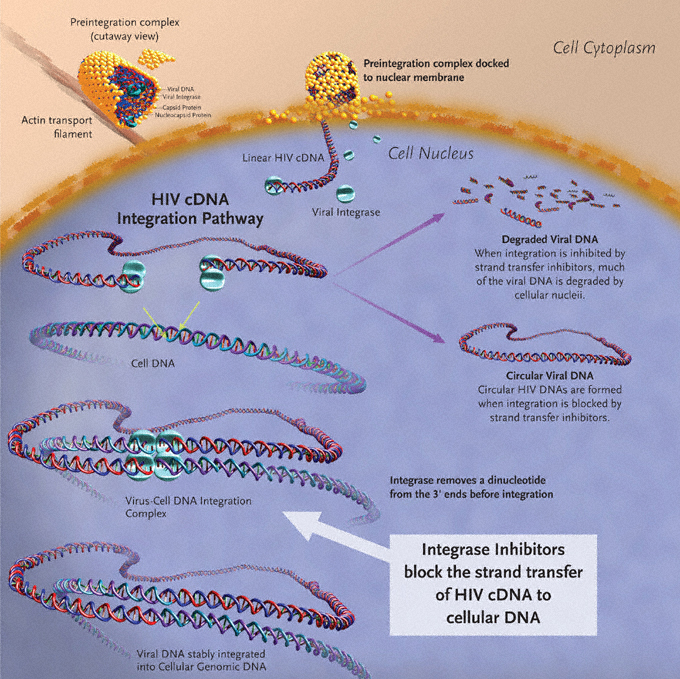
Dormant HIV strains, which have integrated their DNA into
that of the body's cells, can persist for years and are unreachable by
antiretroviral treatments and the immune system. They can reactivate at any
time, which is why HIV
treatment needs to be maintained for life.
Through advances in antiretroviral therapy, an individual
living with HIV can now live a longer, healthier life on treatment. Treatment
works by stopping HIV from infecting new cells. On sustained treatment,
individuals can achieve a level of virus that is undetectable by standard blood
tests. An undetectable viral load means improved health and that the virus is
not transmittable to others -- the concept behind Treatment as Prevention®.
"Previous research had already revealed that the HIV
reservoir was genetically complex. With our method, we can now understand that
complexity with greater granularity, pinpointing exactly when each unique HIV
strain originally appeared in a person," said Dr. Jeffrey Joy,
Research Scientist at the BC-CfE and co-author on the study.
"In order to eradicate HIV from a person's body, you
first need to know the characteristics of HIV in the latent reservoir,"
said Dr. Art Poon, Assistant Professor in Pathology and Laboratory Medicine at
Western University, also a co-author on the study. "We are providing a
method for better measuring the timeline of virus latency and evolution within
an individual living with HIV."
In order to "date" dormant HIV
strains within the viral reservoir, researchers needed to compare these
strains to those that evolved within an individual living with HIV over the
entire history of their infection. The BC-CfE is one of a handful of
institutions worldwide capable of such research, thanks to its maintenance of a
historical repository of blood specimens from individuals diagnosed with HIV in
BC. These specimens date back to 1996 and were originally collected for viral
load and drug resistance testing. The BC-CfE Laboratory has provided HIV
drug resistance genotyping for virtually all Canadian provinces and
territories since 1998, as well as for many countries worldwide.
This research was funded by the Canadian Institutes of
Health Research (CIHR) in partnership with the Canadian Foundation for AIDS
Research (CANFAR) and the International AIDS Society (IAS) through its support
of the Canadian HIV
Cure Enterprise (CanCURE), as well as the US National Institutes of Health
(NIH) through its support of the Martin Delaney BELIEVE Collaboratory.
To be a speaker at STD 2018 Conference being held at
Toronto, Canada, submit your abstracts here: https:/std-hiv-aids.cmesociety.com/abstract-submission