Showing posts with label First-line therapy. Show all posts

Wednesday, 30 May 2018

Integrase Inhibitors: An Overview

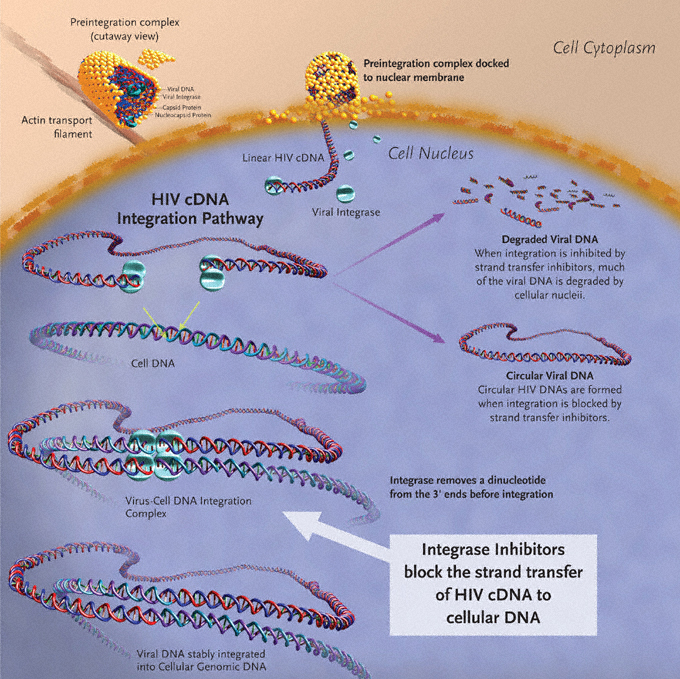
478_integrase_fig1


Integrase inhibitors (also known as integrase strand transfer inhibitors, or INSTIs) are a powerful class of antiretroviral drug which prevents HIV from integrating its genetic coding (genome) into the DNA of the infected host cell. It does so by blocking an enzyme called integrase and, by doing so, makes it impossible for HIV to replicate.

As a class of drugs, integrase inhibitors are considered advantageous in treating HIV infection, with easier dosing requirements, lower side effects, improved resistance profiles, and greater durability.

Current guidance from the U.S. Department of Health and Human Services places integrase inhibitors as a preferred, first-line agent for persons newly treated for HIV. In fact, of the six treatment options currently recommended for newly treated patients, five contain an integrase inhibitor as their backbone drug agent.

Mechanism

HIV integrates its viral genome into the host cell's DNA in a five-step process:
The integrase enzyme binds to HIV DNA, the latter of which is created in a process called reverse transcription.

The HIV DNA is then prepared for integration in a process called cleaving, which literally cleaves the viral genetic strand, leaving open gaps in its structure.

The cleaved strand is then inserted into the host cell's nucleus through a nuclear pore.

Once inside the nucleus, the HIV DNA is transferred into the host DNA in is what's called a strand transfer reaction. In this stage, the viral DNA the literally attacks the host cell's DNA, separating the bonds that hold the host DNA together and attaching itself through the chemical gaps in the viral DNA strand.

The attack then incites a natural protective response called gap repair, in which the host cell will automatically repair any damage to the DNA, essentially facilitating the takeover of its genetic coding.

Simply by blocking the integrase enzyme, the entire integration process is stopped, effectively ending the virus' life cycle. However, as integration is only one of several stages of the HIV life cycles, other drugs are taken to inhibit other stages, further preventing HIV from replicating and ensuring that viral activity is fully suppressed (as measured by the HIV viral load).

Side Effects and Considerations

Unlike other classes of HIV drug, integrase inhibitors work directly on the viral mechanisms themselves rather than on cells. As such, they tend have far fewer side effect, primarily diarrhoea, nausea, fatigue, headache, and insomnia.

Most of these side effects, however, are transient and usually resolve on their own. With that being said, if you experience any adverse event while taking an integrase inhibitor drug combination, advise your doctor or clinic immediately. Do not stop treatment without at least speaking to a qualified professional. Stopping and changing prematurely can do more harm than good.

Similarly, while integrase inhibitors are less to prone to premature drug resistance, you should avoid missing doses or gaps in treatment. Resistance occurs when drug levels in the blood begin to fall, allowing mutant viruses to emerge and proliferate. When this happens, your drugs will not be able to work as well as before and may, in some cases, fail.

Since integrase inhibitors remain in the blood stream for longer periods of time, they are able to suppress HIV mutants even when doses are occasionally missed. But it's important to understand that prolonged interruptions are ill advised and that daily adherence remain key to treatment success.

Source: https://www.verywellhealth.com/integrase-inhibitors-48802
To submit your abstracts, please visit:https://std-hiv-aids.cmesociety.com/abstract-submission

Wednesday, 9 May 2018

State-of-the-art HIV drug could curb HIV transmission in India

An HIV treatment regimen already widely used in North America and Europe would likely increase the life expectancy of people living with HIV in India by nearly three years and reduce the number of new HIV infections by 23 percent with minimal impact on the country's HIV/AIDS budget. The findings from an international team of investigators have been published online in the Journal of the International AIDS Society.

"This study is the first to show that, in India, changing current therapy to a dolutegravir-based regimen would be safer, save lives and prevent new infections -- all without increasing the cost of care," said lead author Amy Zheng of the Massachusetts General Hospital (MGH) Medical Practice Evaluation Center in Boston.
Dolutegravir, developed by the HIV specialist company ViiV Healthcare, has been shown to have fewer side effects and be less likely to induce drug resistance than other currently available HIV drugs. It is currently recommended in North America and Europe as initial therapy for newly infected patients and is available in multiple African countries. A generic version has only recently become available in India.
The researchers used a widely-published mathematical model to project the survival and economic outcomes of adopting a dolutegravir-based regimen as first-line therapy by the Indian health system. Based on cost estimates from the Clinton Health Access Initiative, the analysis assumed the annual cost of the new drug would be $102 U.S. per patient, which is slightly higher than the $98 annual cost of current therapy in India. The team assessed the impact of a dolutegravir-based regimen on life expectancy, the number of new HIV transmissions, HIV care costs and the national Indian HIV budget over 2- and 5-year time horizons.
The results indicated that the new regimen would extend the life expectancy of people living with HIV by 2.8 years and prevent 13,000 new HIV infections over 5 years. Importantly, using dolutegravir as first-line treatment is likely to be cost-effective in 2 years and cost-saving over 5 years -- that is, the clinical and public health benefits would be realized at no additional cost to the national government, compared with the costs of the current regimens. Adoption of dolutegravir-based treatment would likely reduce the number of patients who require a switch to more costly and less effective second- and third-line HIV therapies.
Study author Nagalingeswaran Kumarasamy, MD, chief medical officer of the Y.R. Gaitonde Centre for AIDS Research and Education in Chennai, India, says, "Given the size and scope of the HIV epidemic in India, making a dolutegravir-based regimen first-line therapy through the National AIDS Control Organization will provide tremendous benefit to our patients and to India as a whole."
In late 2017, two India-based pharmaceutical companies agreed to provide a generic, dolutegravir-based combination drug to several African countries for $75 per patient per year, a cost even lower than that of current HIV therapy in India. However, in spite of these new advances in HIV therapy in other nations, generic dolutegravir remains out of reach in India -- both because of its current costs in that country and because it is not yet the standard therapy -- a country in which more than 2 million people live with HIV, the world's third largest population with HIV.
"With India being the world's leading producer of generic HIV therapy, it only makes sense for the tremendous benefits of these therapies to become available to people with HIV in India," added study senior author Kenneth A. Freedberg, MD, MSc, of the MGH Medical Practice Evaluation Center, a professor of Medicine at Harvard Medical School.

Source: https://www.sciencedaily.com/releases/2018/04/180430131843.htm